






 Trap
 Continuous
Ivy Shackles
View:
2800
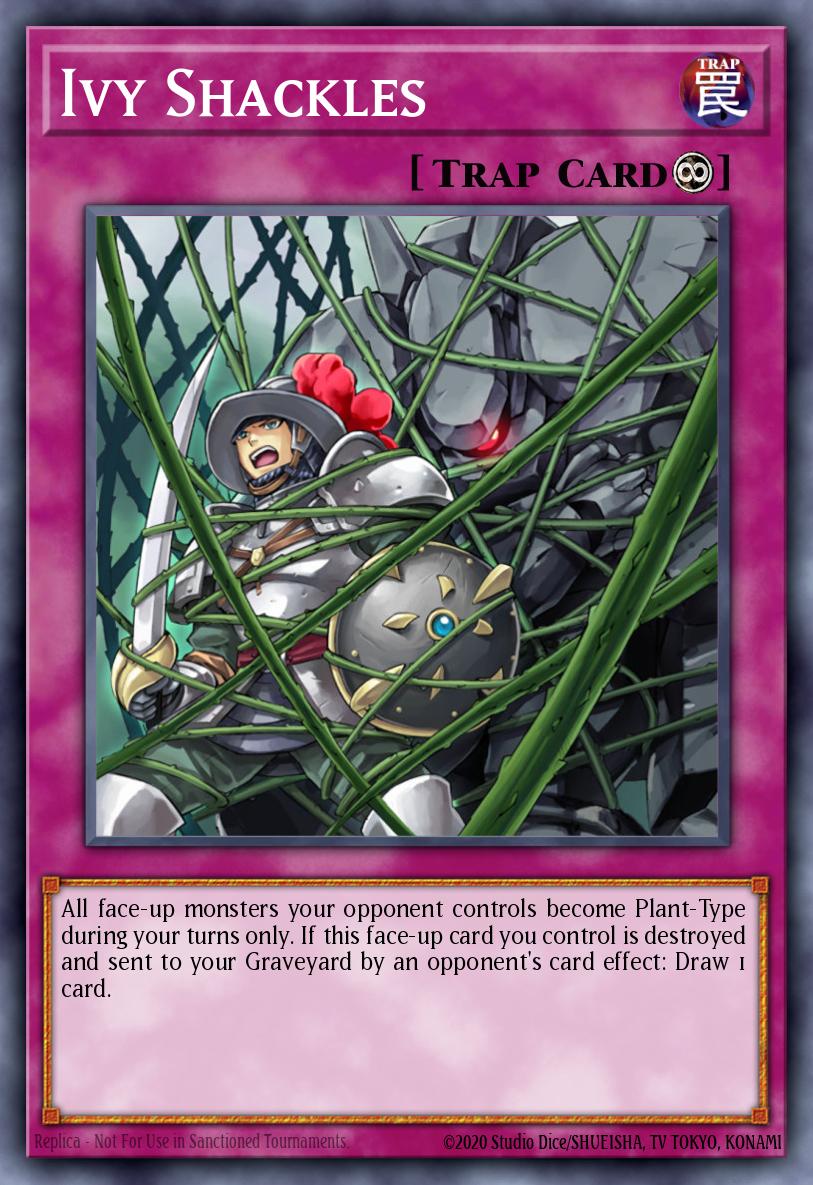
All face-up monsters your opponent controls become Plant-Type during your turns only. If this face-up card you control is destroyed and sent to your Graveyard by an opponent's card effect: Draw 1 card.
Ivy Shackles — Power Evaluation
Final Score: 44 ± 8 · Confidence: Medium
- Intrinsic: 45.5 · Deck: 43 · Meta: provisional
- Primary role: Floodgate/Control · Secondary: Utility
Why it scores here
Ivy Shackles is a Continuous Trap whose main value is a conditional soft floodgate: opponent monsters become Plant-Type during your turns only, and it replaces itself with one card only if the opponent's card effect destroys it. Its score comes from that narrow interaction and the cheap, one-copy deck slot, not from any combo or board-building ability. The evidence has no combo boards (0 appearances), so combo conversion is scored from text alone. The strong Ash Blossom & Joyous Spring co-occurrence (85.7%) is recorded as observed partnership and does not raise the synergy score, because it reflects the card being run in the same generic backrow shell.
Axis scores
| Axis | Score | Evidence |
|---|---|---|
| Accessibility | 45 | A set Trap with no searcher, combo or hand-access evidence; it is live once set but is not reliably reached (inferred, 0 combos). |
| Combo & Conversion | 20 | Text does not build a board or add bodies, and no combo boards record it as a starter, payoff or searched piece (verified text, observed 0 appearances). |
| Resource Economy | 35 | The draw 1 happens only when it is destroyed by an opponent's card effect, so card advantage is conditional and at most +1 (verified text). |
| Effect & Interaction | 35 | Plant-Type conversion of opponent monsters is limited to the controller's turns and is soft interaction, not negation or removal (verified text). |
| Material Utility | 0 | A Trap card has no monster body and cannot be used as material (verified text). |
| Resilience & Flexibility | 40 | It sits face-up in the backrow, so opponent backrow removal can end it, though that removal also draws the card (inferred from text; decks show 7 archetypes of use, observed). |
| Deck-Building Efficiency | 75 | One-copy trap at a 1.14 average copies per deck with no garnet or lock restriction and 7 archetypes, so it is cheap to run (observed from deck data). |
Calculation
Weight profile: Floodgate/Control primary, no secondary blend (secondary Utility carries no weight profile). Intrinsic ≈ 45.5, Deck ≈ 43, Meta = provisional. Modifiers: none. Final formula: 0.40*Intrinsic + 0.60*Deck
Strengths
- Cheap, one-copy backrow slot that fits many archetypes (7 distinct archetypes, observed)
- Draw 1 when destroyed by an opponent's card effect gives it a small return even when removed (verified text)
- Clean timing: the Plant-Type conversion is limited to your turns and needs no cost (verified text)
Weaknesses
- No combo presence in recorded boards (0 appearances), so no observed starter, payoff or board-building role
- Effect is narrow: it changes only the Plant-Type of monsters and does not stop their effects or their attacks (verified text)
- Conditional draw works only when an opponent's card effect destroys it, not for other removal (verified text)
Counters / choke points
- Opponent backrow destruction that is not an opponent card effect would remove it with no draw (inferred from text)
- Opponent turns: the Plant-Type conversion does nothing during their turn (verified text)
Best use
Single-copy backrow floodgate/utility trap in shells that play Plant-Type-sensitive opponent monsters; not a core engine piece. Decks: Goblin Biker, Crimson Dragon, Rose Dragon. Suggested copies: 1.
Evidence & gaps
- Verified: Card text: opponent's face-up monsters become Plant-Type during controller's turns only; Card text: draw 1 when destroyed and sent to GY by an opponent's card effect; Card type: Continuous Trap, one copy in 13 of 14 decks; Legal in TCG, OCG, MasterDuel and DuelLinks format list
- Observed: 14 sampled decks, 7 distinct archetypes, average 1.14 copies per deck; Ash Blossom & Joyous Spring co-occurs in 85.7% of sampled decks; 0 combo boards record the card in any role
- Inferred: Floodgate role is supported by text but not by combo evidence; Backrow removal is the main realistic counter path
- Data gaps: no combos supplied — combo conversion is text-only inference no guides supplied no banlist token — assumed 3 copies (unlimited) no usage statistics (StatisticsCard) — archetype inclusion % inferred from deck sample only